Emotional Release Technique: A Yoga Micro-Practice Guide
A 10–15 minute yoga micro-practice combining hip openers, a supported heart-opener, and breath-led interoceptive noticing can produce measurable parasympathetic shifts and lower cortisol — and you can do it tonight on a folded blanket in your living room or a hotel floor.
TL;DR:
- The most effective yoga-based emotional release technique pairs long-held hip openers (Pigeon, Malasana, Supported Happy Baby) with a supported backbend and a slow exhale-led breath pattern.
- Short, consistent 10–15 minute sessions build a larger window of tolerance over time — occasional intense sessions do not.
- Props (bolster, block, strap, or a rolled towel) create somatic safety by reducing muscular bracing so the nervous system can unwind.
- Yuneyoga carries foldable travel mats, straps, and bundles that cover the minimal kit for home or travel practice.
- Yoga Alliance recognizes yoga-based practices as legitimate wellness tools; heart rate variability (HRV) improvement is a measurable marker of parasympathetic activation.
Your 10-minute micro-practice:
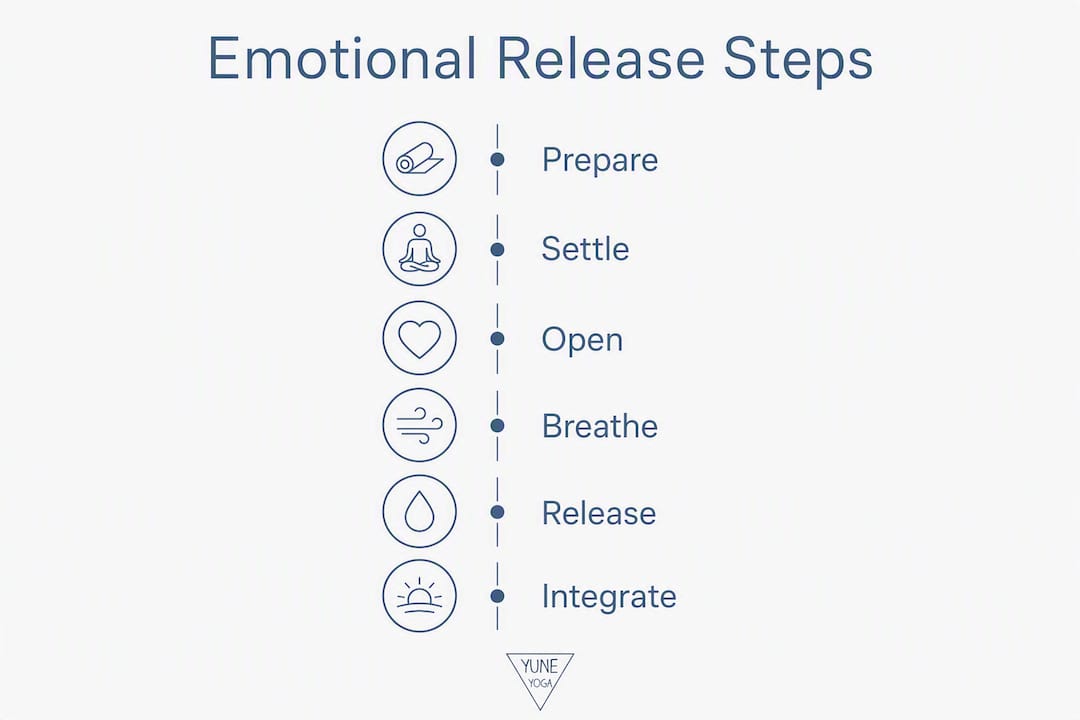
- Arrive: Lie on your back, feet flat, and take three slow diaphragmatic breaths (5-count inhale, 5-count exhale).
- Hip opener: Move into Supported Happy Baby (2–3 minutes, block or rolled towel under each foot if needed).
- Second hip opener: Shift to Malasana squat or low Pigeon (3 minutes per side; sit on a block if hips are high).
- Heart-opener: Lie back over a rolled blanket or bolster placed across the mid-back (2–3 minutes, arms wide).
- Breath cue: During each hold, exhale slowly and notice one physical sensation — its location, texture, or whether it moves.
- Integration: Return to your back, place one hand on your chest, and take three natural breaths. Write one line in a notes app: What shifted, even 5%?
Table of Contents
- Why does yoga release stored emotions?
- Which poses actually release trapped emotions?
- How to use breath and body awareness during poses
- Three ready-to-use sequences for home and travel
- Which props matter most for emotional release work?
- When should you stop and seek professional help?
- How to build a consistent practice that actually works
- Key Takeaways
- The part most yoga guides skip
- Your Yuneyoga travel and home kit for this practice
Why does yoga release stored emotions?
Long-held hip openers and supported chest-opening poses signal safety to the nervous system and permit the discharge of stored tension. The mechanism is somatic, not cognitive.
The psoas muscle — a deep hip flexor running from the lumbar spine to the femur — is one of the primary bracing muscles activated during a stress response. Chronic stress keeps it contracted. Long-held poses targeting the psoas and hip flexors show measurable reductions in cortisol when paired with correct breath and support. That is the physiological core of this emotional healing practice.
Vagal tone connects the picture. The vagus nerve regulates the parasympathetic branch of the autonomic nervous system, and HRV is its most accessible proxy. Slow, diaphragmatic breathing during a supported hold increases vagal tone, which lowers autonomic reactivity and creates the physiological conditions for emotional material to surface and discharge safely.
Trauma-informed practice adds three principles on top of that physiology:
- Choice: The practitioner decides when to enter, stay, or exit a pose. No forcing.
- Titration: Short holds, repeated often, rather than one prolonged intense exposure.
- Grounding: Physical contact with the floor or a prop keeps the nervous system anchored.
Yoga Nidra and long supported holds give the subconscious access to stored emotional material without the resistance of rational thought — which is why restorative sequences often produce unexpected emotional responses even in experienced practitioners.
Which poses actually release trapped emotions?
The two essential families are hip openers and heart-openers. Hip openers address psoas and groin tension where stress accumulates physically; heart-openers decompress the chest and thoracic spine where emotional bracing tends to live.
Hip openers
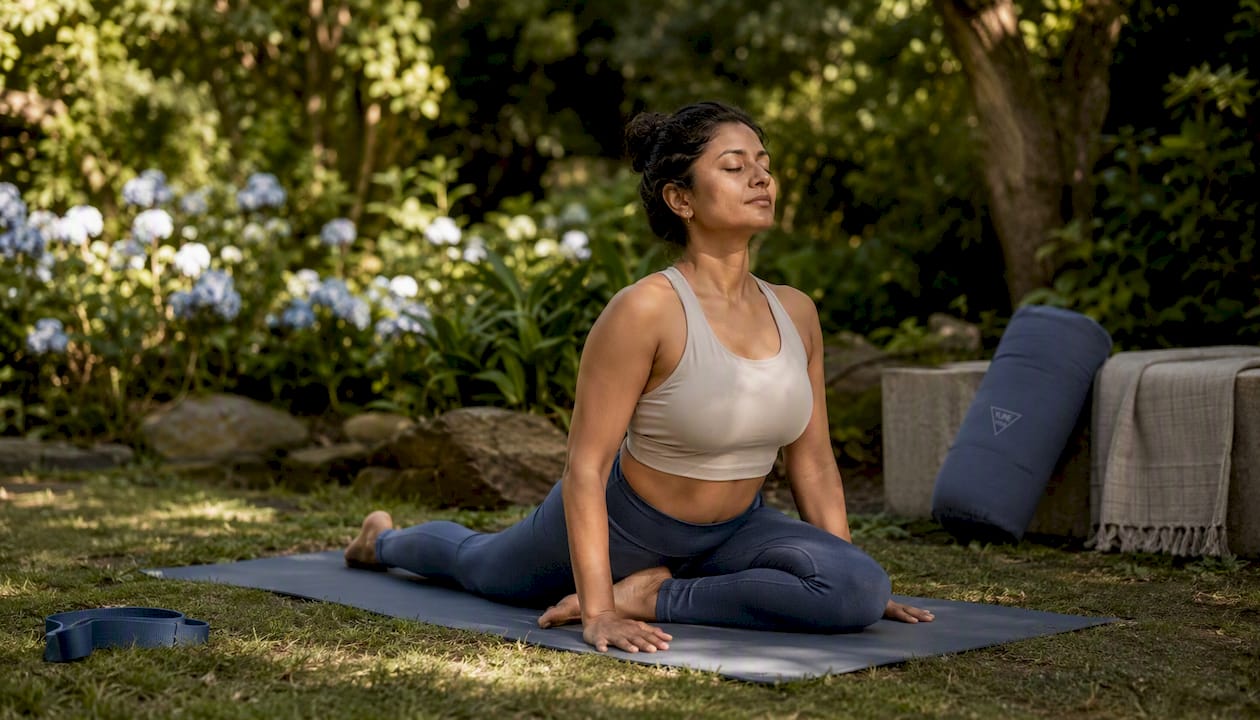
- Supported Pigeon: Front shin parallel to the mat, bolster or folded blanket under the hip of the bent leg. Hold 3–5 minutes per side. Breath cue: exhale and soften the outer hip. Notice: heaviness, pulsing, or heat in the hip socket.
- Malasana (Squat): Feet hip-width, heels on a rolled mat or block if they lift. Hold 2–3 minutes. Notice: pressure in the groin, any urge to shift weight.
- Supported Happy Baby: On your back, knees wide, blocks or a rolled towel under each foot. Hold 3–5 minutes. This is the most accessible version for travel or injury-sensitive practitioners.
Heart-openers
- Supported Bridge: Hips lifted over a block at its lowest height. Hold 3–5 minutes. Breath cue: inhale into the chest, exhale and let the sternum drop toward the block.
- Supported Backbend (Fish or Puppy variation): Bolster or rolled blanket across the mid-back, arms wide. Stacking bolsters for a supported backbend creates a cocoon effect that lets the chest open more deeply without risking soft-tissue overstretching. Hold 3–5 minutes.
- Camel (modified): Hands on lower back, gentle thoracic extension only. 60–90 seconds. Skip if you have acute lower-back sensitivity.
Hold timing guidance:
| Hold Duration | Best For | Safety Note |
|---|---|---|
| 1–3 minutes | New practitioners, high activation states | Exit if intensity reaches 7/10 |
| 3–5 minutes | Regular practice, moderate emotional load | Use props to reduce muscular effort |
| 5–15 minutes | Experienced restorative practice | Titrate; set a timer |
Pro Tip: For hotel floors or plane layovers, Supported Happy Baby with a rolled jacket under each foot and Malasana against a wall cover both pose families with zero props.
How to use breath and body awareness during poses
Diaphragmatic breathing and coherent 5/5 breathing stabilize HRV and reduce autonomic reactivity — pairing either pattern with a held pose amplifies the release effect.
Three breath patterns, in order of intensity:
- Diaphragmatic breath: Inhale 4 counts through the nose, belly rises first. Exhale 6 counts, belly falls. Repeat for the full hold duration. This is the baseline for all poses.
- Coherent 5/5 breath: Inhale 5 counts, exhale 5 counts, no pause. Synchronizes heart rhythm and vagal tone most efficiently.
- Expressive exhale: A short, audible sigh or “ha” exhale through the mouth. Use once or twice mid-hold when sensation peaks — not as a default pattern.
Interoceptive noticing prompts (shift attention from story to sensation):
- Where exactly is this sensation? Can you point to it?
- What is its texture — sharp, dull, buzzing, heavy?
- Is it moving, spreading, or staying still?
Shifting from emotional narrative to precise body sensation mapping — location, texture, motion level — is what differentiates yoga-based release from cognitive processing. The sensation does not need a story to resolve.
Pro Tip: If sensations spike suddenly, open your eyes, press both feet firmly into the floor, and count four slow exhales. This grounds the nervous system without ending the practice.
Three ready-to-use sequences for home and travel
The 10-minute travel routine fits a hotel room; the 15-minute home restorative uses a bolster; the 5-minute seat adaptation works mid-flight.
10-minute travel routine (floor, minimal props)
- Diaphragmatic breath lying down — 2 minutes.
- Supported Happy Baby with rolled towel — 3 minutes.
- Low Pigeon or figure-four stretch — 2 minutes per side.
- Supported backbend over rolled blanket — 2 minutes.
- Micro-shake: lying on your back, gently shake hands and feet for 30 seconds, then rest.
15-minute home restorative (bolster recommended)
- Diaphragmatic breath — 2 minutes.
- Supported Pigeon with bolster under hip — 4 minutes per side.
- Supported backbend over bolster (Fish variation) — 4 minutes.
- Coherent 5/5 breath in Savasana — 3 minutes.
- One-line journal note.
5-minute seat or plane adaptation
- Seated diaphragmatic breath — 1 minute.
- Figure-four stretch in seat (ankle on opposite knee, gentle forward fold) — 90 seconds per side.
- Short 2–5 minute breathing practices and brief hip-opening micro-movements are effective between tasks or during travel — finish with three slow expressive exhales.
When props are unavailable, a folded jacket replaces a bolster and a rolled scarf substitutes for a strap. Micro-shaking and small voluntary movements during restorative sequences encourage interoceptive feedback and release without any equipment at all.
Which props matter most for emotional release work?
A bolster, a foldable travel mat, a strap, and one block (or a rolled towel) cover every pose in this guide. That is the complete kit.
- Bolster: Supports the chest in backbends and the hip in Pigeon. Travel alternative: two bed pillows stacked.
- Block: Raises the floor for Malasana and supports Bridge. Travel alternative: a thick hardcover book.
- Strap: Maintains alignment in hip openers without muscular effort. Travel alternative: a belt or scarf.
- Foldable travel mat: Provides grip and cushioning on hotel carpet or tile. A folded yoga towel works for short sessions.
Travel kit checklist:
- Foldable or roll-up travel mat (under 2 lbs)
- Compact strap or belt
- One inflatable or foldable mini bolster (optional but high-impact)
- Yoga towel (doubles as mat surface and prop)
Pro Tip: Yuneyoga’s foldable travel mats and yoga straps are built for exactly this kind of minimal, restorative kit — lightweight, packable, and durable enough for daily use on the road.
When should you stop and seek professional help?
Tears, sighs, and mild shaking during a practice are normal physiological discharges. They do not require intervention. Stop immediately and ground yourself if emotional intensity reaches 7 out of 10 or higher.
Red flags — stop the practice and ground:
- Panic-level heart rate or hyperventilation
- Dissociation (feeling detached from your body or surroundings)
- Intrusive trauma memories that feel uncontrollable
- Any thought of self-harm
Immediate grounding steps:
- Open your eyes and look around the room.
- Name five objects you can see.
- Press both feet firmly into the floor.
- Take four slow exhales, longer than the inhale.
- Place one hand on your chest and one on your belly.
Seek support from a licensed therapist or trauma-informed yoga therapist if intense reactions occur repeatedly, if dissociation is frequent, or if the practice consistently raises rather than lowers distress. Yoga-based energy release techniques are a complement to professional care, not a replacement. For injury-sensitive modifications that keep the practice safe, Yuneyoga’s blog covers somatic-safety approaches in detail.
This article is general wellness information, not medical or psychological advice. Consult a qualified professional for persistent or severe emotional distress.
How to build a consistent practice that actually works
Short, consistent 10–15 minute sessions build a larger window of tolerance over time — sporadic intense sessions do not. Titration, not drama, is the mechanism.
Habit-building checklist:
- Anchor the practice to an existing ritual (morning coffee, pre-sleep wind-down).
- Set a recurring phone reminder with a one-word cue (“hips” or “breathe”).
- Keep your mat and strap visible — friction kills consistency.
- Aim for 3–5 sessions per week, not daily perfection.
Simple tracking template:
| Date | Length (min) | Dominant sensation | Intensity |
|---|---|---|---|
| Example | 15 | Heaviness in left hip | 4 |
Over 4–8 weeks of regular practice, most practitioners notice a wider window of tolerance: sensations that once felt overwhelming become observable. Short yoga sessions also support broader stress resilience when practiced consistently. After each session, write one line: What shifted, even 5%? That single habit, drawn from somatic integration research, reduces rumination and supports consolidation.
Key Takeaways
Short, consistent yoga-based emotional release sessions using hip openers, supported heart-openers, and diaphragmatic breath build a larger window of tolerance than any single intense practice ever will.
| Point | Details |
|---|---|
| Consistency over intensity | 10–15 minute sessions practiced 3–5 times weekly build tolerance more effectively than occasional long sessions. |
| Props create somatic safety | Bolsters, blocks, and straps reduce muscular bracing so the nervous system can unwind and release. |
| Interoceptive noticing | Shift attention from emotional narrative to sensation location, texture, and motion to support safe release. |
| Safety threshold | Stop and ground immediately if intensity reaches 7/10; seek professional support for persistent severe reactions. |
| Yuneyoga travel kit | Yuneyoga’s foldable mats, straps, and bundles cover the minimal kit for both home and travel practice. |
The part most yoga guides skip
The conventional framing of emotional release in yoga tends toward the dramatic: a deep hip opener, a flood of tears, a breakthrough. That framing is not wrong, but it sets the wrong expectation and, for many practitioners, creates subtle pressure to perform an emotional response.
What the research actually supports is quieter. The nervous system does not release stored tension because you pushed hard enough or held long enough. It releases because it finally felt safe enough. That distinction changes everything about how you practice. A five-minute Supported Happy Baby where you genuinely notice one sensation without trying to amplify it is more therapeutically useful than a 20-minute Pigeon where you are mentally narrating your grief.
The other thing guides understate: props are not a beginner’s crutch. They are the mechanism. A bolster under the chest in a supported backbend removes the muscular effort that keeps the thorax braced, and that removal is precisely what allows the nervous system to shift. Skipping props to feel more “advanced” is the equivalent of removing the safety net and calling it skill.
Short, honest, well-supported practice — three times a week, with a strap and a rolled towel — will do more for your emotional regulation over six months than any single cathartic session. The body learns safety through repetition, not intensity.
Your Yuneyoga travel and home kit for this practice
The minimal kit for this entire guide fits in a carry-on: a foldable travel mat, a compact strap, and a yoga towel that doubles as a bolster substitute.
Yuneyoga builds exactly this kind of kit. The foldable travel mats are lightweight and grippy enough for hotel tile; the yoga straps are durable and compact; and the yoga towels pull double duty as both mat surface and rolled prop support. No bulk, no compromise on the practice.
- Foldable travel mat: Grip and cushioning on any surface, under 2 lbs.
- Yoga strap: Maintains alignment in hip openers without muscular strain.
- Yoga towel: Mat surface, bolster roll, and sweat layer in one piece.
Browse Yuneyoga’s travel bundles and home practice gear at yuneyoga.com and build the kit that fits your practice — whether that is a hotel room in Denver or a living room floor at 7 AM.